Salesforce custom code audit against EU banking rules
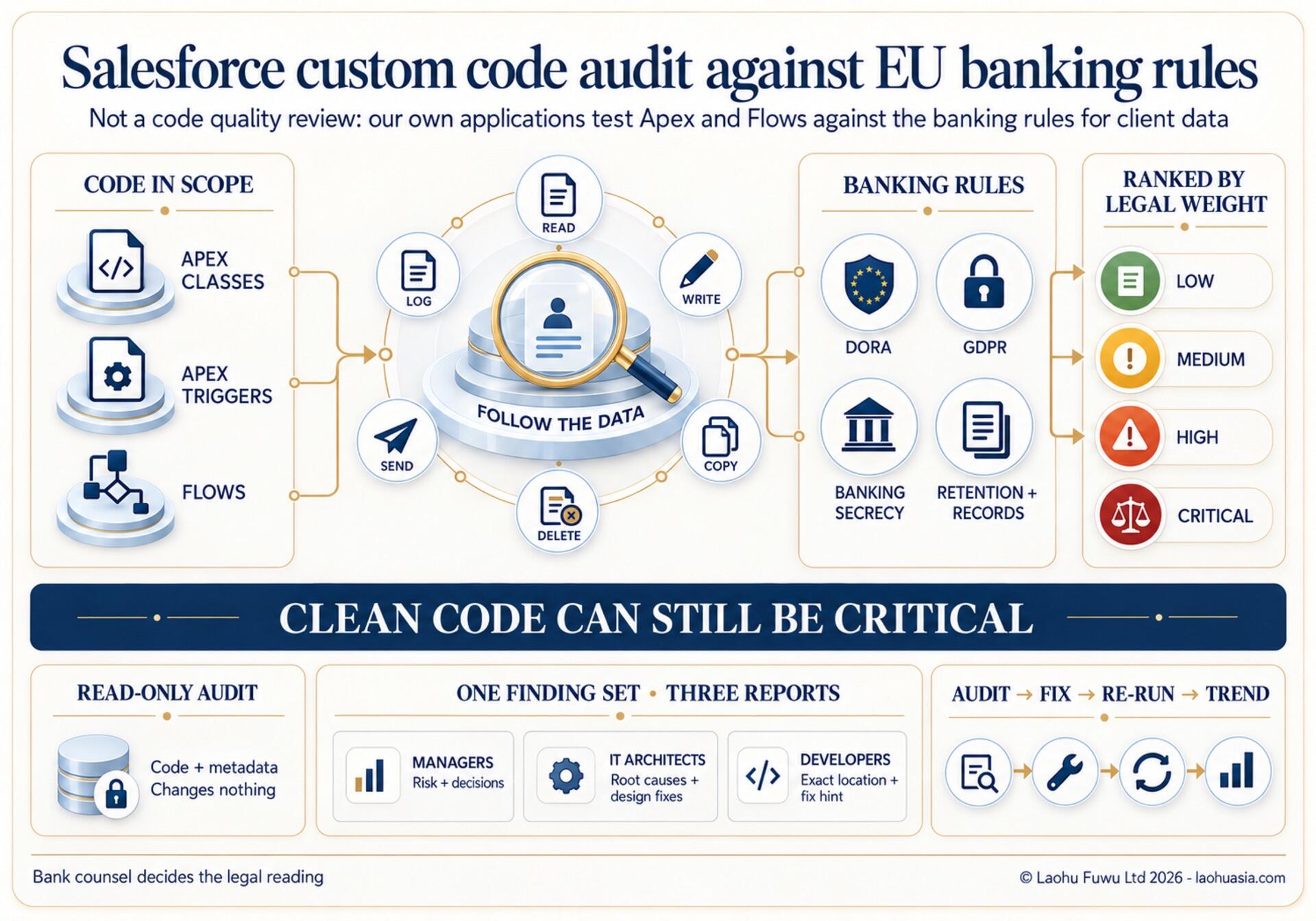


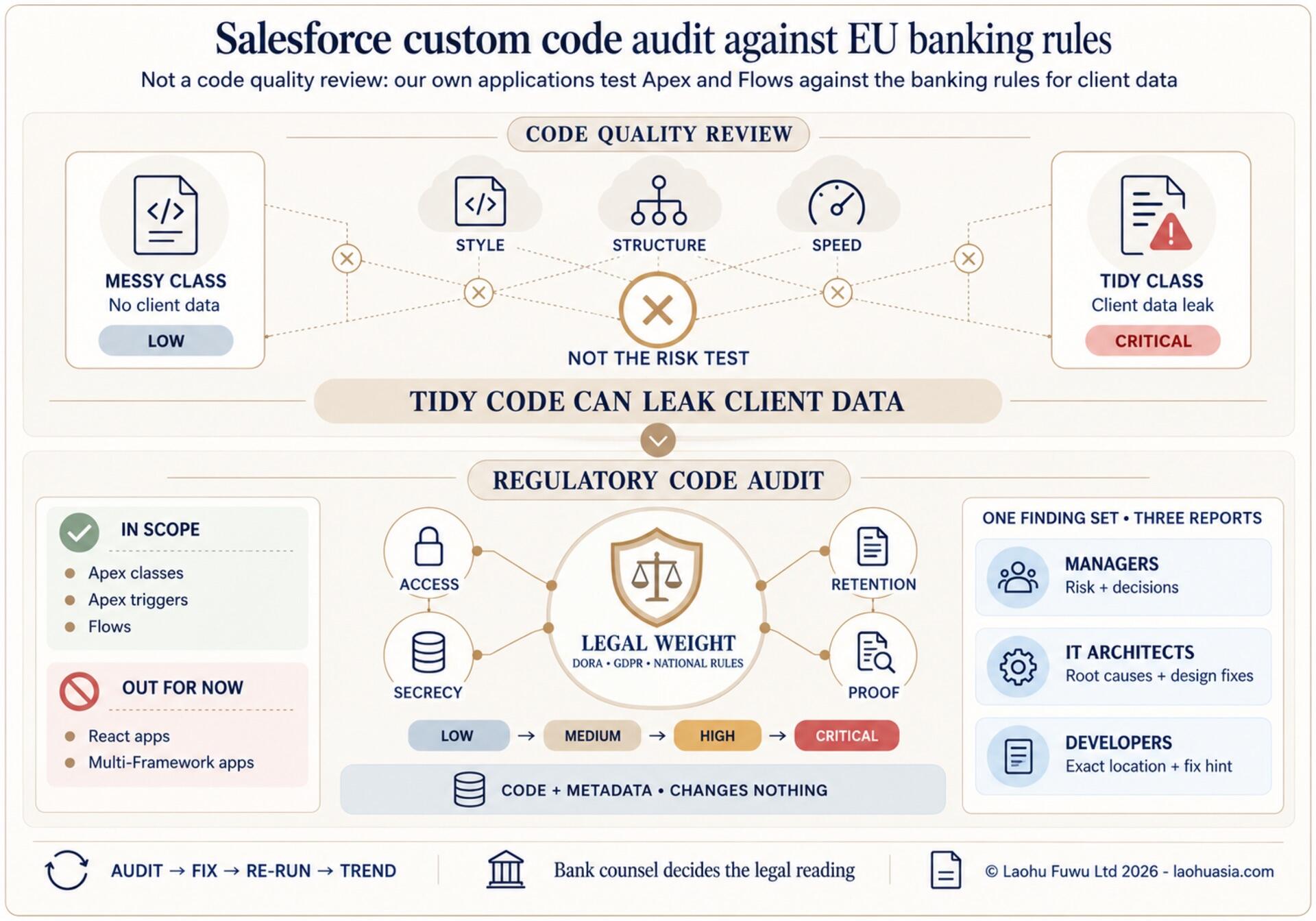
Most Salesforce code reviews ask one question: is the code clean? But a Salesforce custom code audit for a bank asks a different one. Does the code handle client data as the banking rules require? Banks hold data under strict rules on access, secrecy, retention and proof.
“Not a code quality review: our proprietary applications audit custom Apex code, Salesforce flows against the banking rules for client data.”
So custom code can break any of them. Our proprietary applications analyze the custom salesforce code and rank each finding by its legal weight. We audit and advise, and we do not implement.
For now, a Salesforce custom code audit covers the following custom code: Apex, flows, Aura & LWC components. These are the places where a bank’s own rules touch client data. Apex classes hold logic that reads and writes records. Triggers run on every save, so they shape what the bank stores and logs. Flows automate steps such as updates and messages. However, React apps and Multi-Framework apps are outside the scope for now. Our applications read the code and its metadata, and they change nothing in your org.
A Salesforce custom code audit tests code against the strict rules on banking data. Under (DORA), a bank must review source code and act on what it finds. Under the [GDPR](https://eur-lex.europa.eu/eli/reg/2016/679/oj/eng), a bank must keep personal data secure and [erase it when the law says so](https://laohuasia.com/portfolio-item/data-360-audit-for-banks/). National rules add banking secrecy, conduct and record-keeping duties, and each country reads them in its own way. A supervisor does not ask whether the code is elegant. Instead, the supervisor asks whether the bank knew about the risk and acted. The audit gives the bank that record. We are not a law firm, so the bank’s counsel decides the legal reading.
A Salesforce custom code audit ends in three reports from one set of findings. Managers get a short summary of risk and decisions. IT architects get the root causes and the design fixes. Developers get the exact code location and a fix hint. Every finding has a severity from low to critical, set by legal weight and never by code quality. A critical finding comes first. We then re-run the audit after the fixes. That shows a supervisor a trend, not a snapshot.
E-mail: consulting@laohuasia.com
Support: Video Call